AI in music software
Can Claude hear music? What it reads instead of sound
Claude takes text and images, not audio. A second Claude read pictures, measurements and session files of six versions of one track: what each view caught.
The short answer. No. On 24 November 2026 Anthropic documents text and image input for every current Claude model and no audio input, and voice mode turns your speech into text. A Claude that works on a track reads a picture of the sound, measurements of it, or the session itself: in our blind test a second Claude found all five planted faults in the session files, four in the measurements and three in the spectrograms, one of those only as "louder". Read alone, with nothing to compare, a spectrogram missed a filter that took the top off the drums.
We make monody, a DAW with an MCP server built in. The test track and all three of its views came out of it.
What Claude takes in
Anthropic's models overview says: "All current models support text and image input, text output". The Files API takes documents (PDF, plain text), images (JPEG, PNG, GIF, WebP) and files for the code execution tool, whose list of upload types names no audio format (the page mentions MP3 and WAV only as files Claude's code can produce). The OpenAI-compatible endpoint answers an input_audio part with a 400 error. In the apps, file uploads take documents and images.
Voice mode is a spoken conversation, but its help page says your speech is converted to text and kept as a transcript, and Claude Code's dictation transcribes speech into the prompt. None of these pages describes Claude hearing music.
Community skills get around it by turning audio into something Claude does take, such as spectrograms, pitch lines or MIDI, or by sending it to another model that takes audio; the skills table in Claude Skills for music production lists them, most under Analysis.
Three stand-ins for sound
The test track is a three-minute, four-track tech house arrangement made in monody: Hook, Drums, Bass and Pad, 96 bars at 128 BPM in A minor. Every view covers the same 16 bars, 33 to 48, where all four tracks play.
A picture. A spectrogram of the render, drawn by one script for every version: frequency up the side, bars along the bottom, level as colour, the left channel above the right.
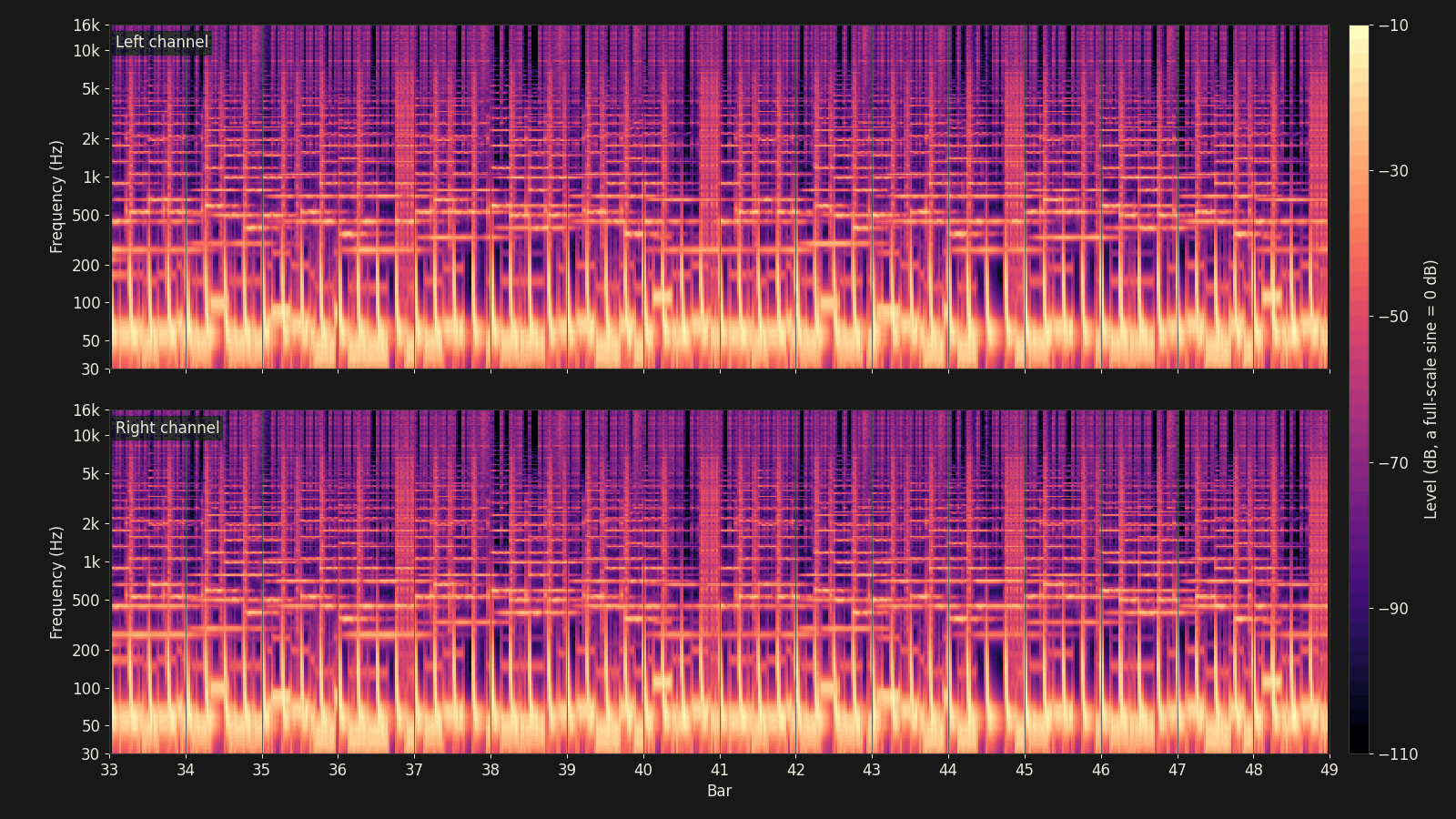
Measurements. What monody's analyze_mix reports for the whole song, its numbers and its own findings, followed by a measurement of the 16 bars alone. Four lines from the clean version, track ids cut:
Master: −17.0 LUFS integrated, short-term max −15.7, LRA 3.2 LU, true peak −1.6 dBTP, PLR 15.4 dB, correlation 0.96, low-end correlation 1.00, tilt −5.9 dB/oct (balanced ~ -4.5).
Bands (dB): 20–40 Hz −32.6 40–80 Hz −21.2 80–160 Hz −24.0 … 5k–10k Hz −42.2 10k–20k Hz −40.8
- Hook […] −22.7 LUFS, peak −13.0 dBFS, 18% of mix, mostly low mids
- Bass […] −23.9 LUFS, peak −17.6 dBFS, 15% of mix, mostly sub
The session. What get_project returns over MCP: each track's devices and their settings, its fader and pan, and every note. The Bass, trimmed:
"name": "Bass", "pan": 0.0, "volumeDb": 0.0,
"chain": [ { "type": "instr.poly", "name": "Sub Bass", … }, …,
           { "type": "util.tool", "params": { "monoBelowHz": 200.0, "monoOn": 1.0, "width": 1.0, … } }, … ],
"clips": [ …, { …, "notes": [ { "lengthBeats": 0.9, "noteId": "…", "pitch": 33, "startBeat": 0.5, "velocity": 109 }, … ],
            "startBeat": 160.0, … } ]
Six versions, five faults
Five copies of the song got one fault each, each from a different family; one stayed clean:
| Version | The fault, as a producer would say it | What we changed |
|---|---|---|
| Clean | none | nothing |
| Hook loud | the lead sits on top of everything | Hook fader +6 dB, its maximum |
| Drums filtered | a filter left on after a build: no hats, no air | a DJ Filter at −0.45 (a low-pass at about 1.07 kHz, 24 dB per octave) at the end of the Drums chain |
| Bass left | the sub comes out of one speaker | Bass pan −1.0 |
| Squashed | the master limiter pushed far too hard | a Maximizer on the master, +20 dB into a −0.3 dB ceiling (a first try at +14 dB measured like an ordinary loud club master and was undone) |
| Wrong notes | the bass a semitone sharp for four bars | the 22 bass notes in bars 41 to 44 raised one semitone |
Each fault went in alone, through monody's MCP server, and came out with Undo; after each one we read the project back and checked that it matched the clean read.
The reader was a second Claude that had seen nothing: Claude Opus 5.5, fresh, with one folder holding three subfolders, one per view, six items each, each subfolder in its own random order with its own labels. Any number of the six, it was told, might have a fault: a mistake a producer would want fixed, not a matter of taste. For each item it answered faulty or not, what and where, how sure from 1 to 5, and how it decided, working through pictures, then measurements, then sessions, without comparing across folders. Four more fresh readers got one item each, with nothing to compare.
Hear the six versions
The same 30 seconds of each render, as measured. Claude judged them without hearing them; listen and judge each fault yourself.
What each view caught
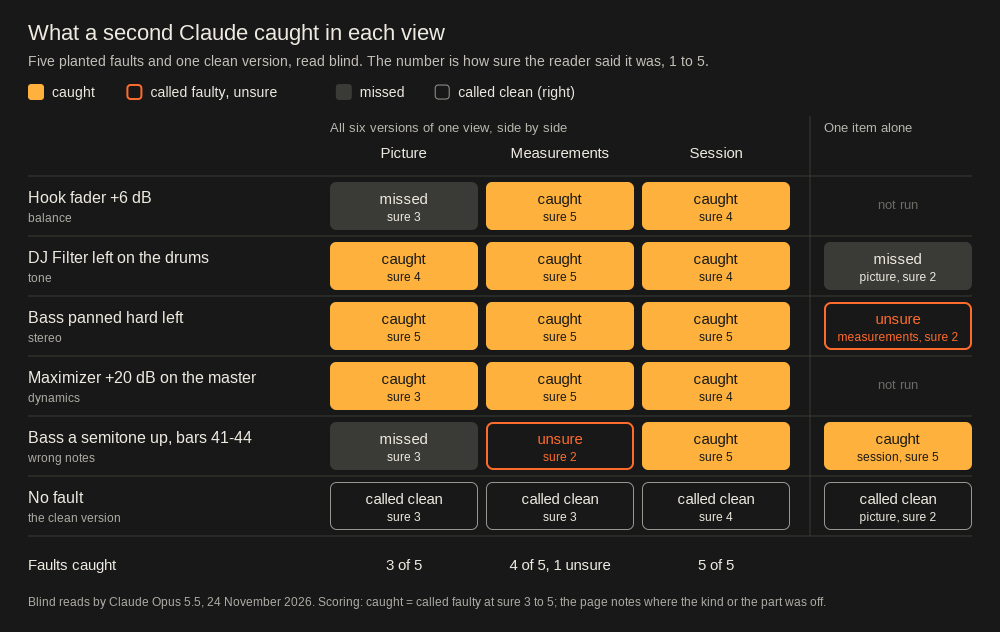
| Fault | Picture | Measurements | Session |
|---|---|---|---|
| Hook loud | missed (3): "matches P2 and P5 in every band and channel I could compare" | caught (5), citing the Hook fader at +6 dB | caught (4) |
| Drums filtered | caught (4), but blamed the master: "as if a low-pass were left on the master" | caught (5), with the cutoff guessed at 3 to 5 kHz | caught (4) |
| Bass left | caught (5): "the right side holds only the kick hits" | caught (5), from low-end correlation 0.72 | caught (5) |
| Squashed | caught (3) as louder or clipping, not as limiting: "I cannot tell whether it is a real fault or only a louder bounce" | caught (5) as a master driven about 9 dB too hot and clipping; the limiter was not named | caught (4) |
| Wrong notes | missed (3) | unsure (2): "it reads 0.1 LU louder" | caught (5), every pitch named |
The number in brackets is how sure the reader said it was. The clean version was called clean in all three views.
The session caught everything because every fault was a value: a fader at 6.0, a DJ Filter that wasn't there before, a pan at −1.0, a Maximizer with gainDb 20, and 22 notes a semitone up, 19 of them outside A minor. Side by side, each was "the only difference" from the other sessions. Alone, a single session with the wrong notes was read just as exactly, at sure 5, from the key and from the second bass clip repeating the first one a semitone higher: "A#1, G#1, C#2, F2, F#1 instead of A1, G1, C2, E2, F1".
A picture needs a reference
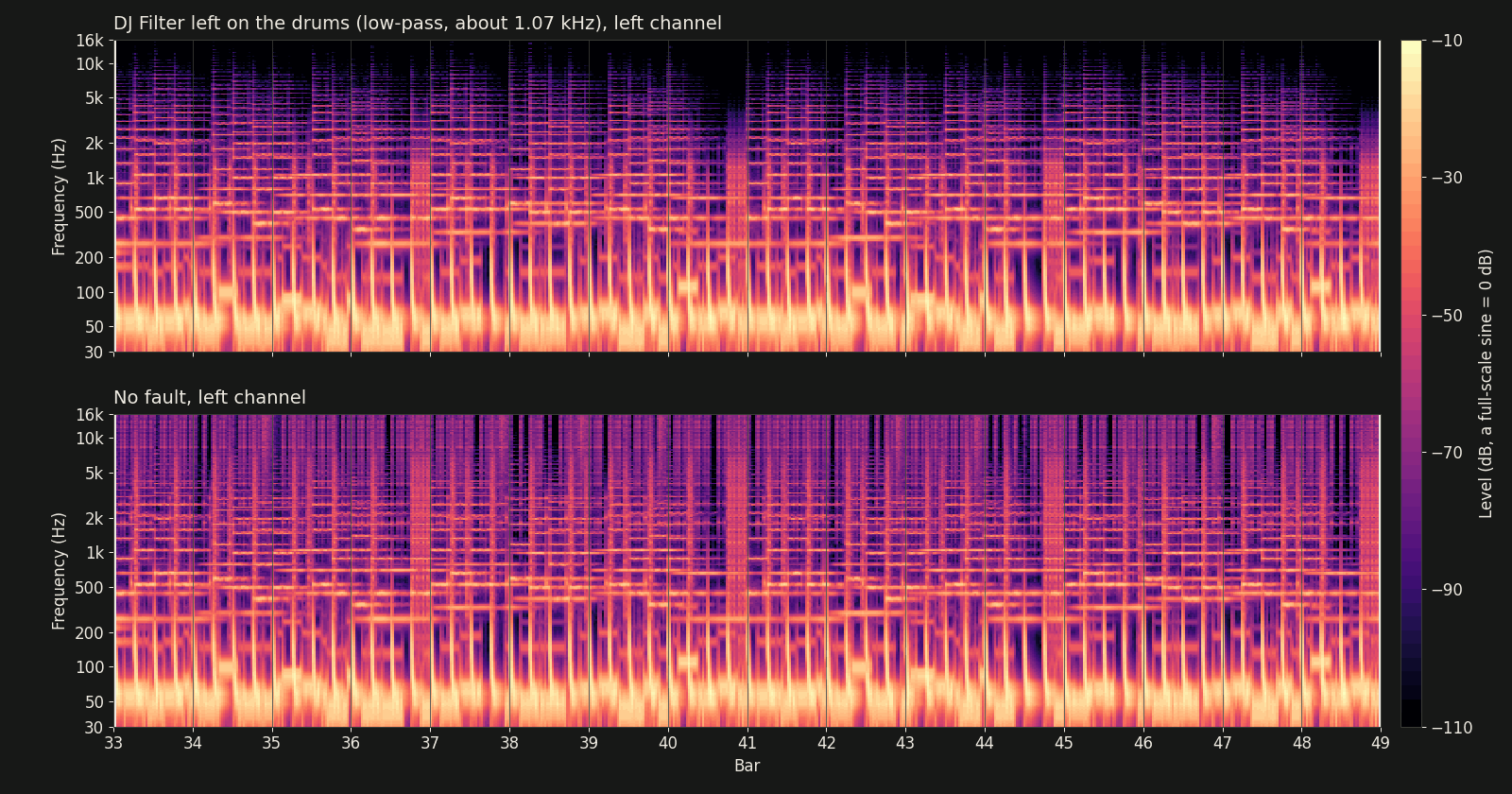
The reader of the top picture saw the evidence and didn't trust it: "The only odd things are global (strong sub, almost nothing above about 10 kHz), and with nothing to compare against I can't call those a fault." It said it first took the "Left channel" label box in the corner for cymbal air. The clean picture, also read alone, got the same verdict at the same sureness.
Next to the other five, the same picture was caught at sure 4: "Its 10-16 kHz band is dark where P2, P3, P4, P5 and P6 all show a filled band of hat streaks up to 16 kHz." The picture's surest catch, at sure 5, was the bass panned left, and that picture carried its own reference: "The left and right panels differ only in the 60-250 Hz band…" A spectrogram shows what is there. Whether that is wrong takes a second picture.
Two faults no picture showed
The hook 6 dB hot. The colour scale moves in 2 dB steps, so +6 dB is three shades brighter on the hook's lines, which run among the pad's. Comparing all six pictures, the reader called it clean. The measurements put it at 47% of the mix, against 18% in the clean version. A level is a number; a picture turns it into a shade.
The wrong notes. This picture's frequency steps are 11.7 Hz wide (a window of 4,096 samples at 48 kHz). A1 and A#1 are 3.3 Hz apart. Higher up, where the bass's harmonics separate, a semitone is about two rows of the picture. And no picture says which notes belong to A minor. The session states the key, and the notes are numbers that can be checked against it.
What to give Claude for your own track
- The session, first. Through your DAW's MCP server Claude reads faders, pans, devices and notes as values. Four of these five faults were one setting each and the fifth was notes against the key. Claude for music production covers connecting a DAW, and DAW MCP servers shows what each server can read.
- Measurements of a render, with a baseline. Next to five other versions the numbers caught four faults at sure 5. Alone, with the tool's own "Wide low end" warning in the item, the hard-panned bass still got sure 2, as "too wide for a club track". Give Claude a previous bounce or a reference measured the same way, at a matched level (why matching matters).
- A spectrogram, only in pairs. Your mix and a reference, on the same scale. Alone it passed a mix whose hats had been filtered off, and a clean mix, with the same shrug.
- Not one of these says whether it sounds right. Whether a hot hook is a mistake or the point of the track is a call made by ear, and so is how loud a master should be (targets by platform). A whole mix and master over MCP, with what Claude changed and missed: Can Claude mix and master?
What this test is not
- One song, one model. Five gross faults, each alone, sized to be plain to a listener. A real mix carries several small ones at once.
- One reader did all three side-by-side views, pictures first and sessions last, so the later views were not read cold.
- Six versions side by side is a luxury. A producer with one mix has nothing to compare it to, which is why we ran the alone-reads. There were four of them, one item each.
- The measurements came with their own hints. The measurement of the 16 bars lists each track's fader beside its level, so the loud-hook item showed the Hook at +6 dB; we flagged that before the test, and the reader used it. The whole-song items also carried the tool's own findings: four faulty versions had a warning the clean one did not (Wide low end, Dull top end, a low-mid build-up naming the Hook, clipping). The wrong-notes item had none, and it is the one the reader was unsure about.
- The readers did not hear anything either. They read files.
We ran this on 24 November 2026 with monody 0.9.7 on a Mac and Claude Opus 5.5 in Claude Code. Every change, render and read of the project went through monody's built-in MCP server on the same computer and was logged: 118 calls, two of them refused (a read too large for one answer, and a fader value above the +6 dB maximum). The server played into a silent test device, and all six renders reproduce bit for bit in the released 0.9.7 app. The pictures come from our own script: Hann window of 4,096 samples (85 ms) at 48 kHz, colour scale −110 to −10 dB in 2 dB steps, one palette for all six. The audio is 60 to 90 seconds of each render, encoded with FFmpeg at 192 kb/s and not normalised. The five readers ran on the same model, each fresh, given its folder and a short instruction to fill the template, say how it decided and stay inside the folder; the prompts are in the answers file. Downloads: blind-test-pack.zip, the pack as the reader got it, to try on another model or on yourself; the answer key; every answer, scored; every call of the build in build-log.json. In the downloads one internal label, four ids that named our test setup and local folder paths are replaced; nothing else is changed. MCP in monody is on every plan, Free too (pricing), and needs a monody account and your own Claude Code access; MCP calls do not spend monody's AI credits.
Sources
- Anthropic: Models overview, Files API, Code execution tool, OpenAI SDK compatibility (all read 24 November 2026)
- Claude Help Center: Upload files to Claude (updated 23 July 2026), Use voice mode (read 24 November 2026)
- Claude Code: Voice dictation (read 24 November 2026)
- This test: blind-test-pack.zip, answer-key.json, reader-answers.json, build-log.json (24 November 2026)
- monody: MCP server and tool list (read 24 November 2026), plans (read 26 November 2026)
Claude, Claude Code and FFmpeg are trademarks of their owners. monody is not affiliated with or endorsed by Anthropic or the FFmpeg project.
Questions
- Can Claude hear music?
- No. On 24 November 2026 Anthropic's documentation lists text and image input for every current Claude model and no audio input. A Claude that helps with music works from a picture of the sound, measurements of it, or the session's notes and settings.
- Can Claude listen to music in voice mode?
- No. Voice mode is for speaking with Claude, and Anthropic's help page says your speech is converted to text and kept as a transcript. It says nothing about music, and mentions other sounds only as background noise that gets in the way.
- Can Claude analyze audio?
- Not as sound. It can read a spectrogram image, numbers a tool measured from the audio, or the notes and settings of the session. In our blind test a second Claude found all five planted faults in the session files, four in the measurements and three in the spectrograms, one of those only as louder.
- Does the Claude API accept audio files?
- Anthropic's Files API sends an upload to Claude as a document, an image or a file for the code execution tool, and its OpenAI-compatibility page says a request with an input_audio part returns a 400 error.
- Can Claude hear my song?
- Not directly. Give it your session through your DAW's MCP server and measurements of a render, and a spectrogram only next to a reference. Whether the song sounds right is still yours to judge by ear.