Mixing and mastering
Can Claude mix and master a song? We planted five faults to find out
We planted five mix faults in a tech house track and handed it to Claude over monody's MCP server: what it found, changed and left alone, with audio and numbers.
The short answer. Claude can't hear your mix. Connected to a DAW that shows it every setting and measures a render, it can find level, EQ and pan problems, fix them as exact, undoable edits and master to a loudness target. We planted five faults in a three-minute tech house track. Claude found all five, fixed them in three edits and mastered to −14.0 LUFS. Whether the kick is the right kick is still a call for someone who can hear it.
We make monody, a DAW with an MCP server built in, so this test runs on our app. It is one session, logged call by call, with the files to check it.
The test
The song is a three-minute, four-track tech house test arrangement made in monody: Hook, Drums, Bass and Pad, 96 bars at 128 BPM in A minor. We made five changes in one batch and saved the result as a copy, so its undo history did not show them. Claude Opus 5.5, in Claude Code, got the copy and this request:
This is my tech house track, about three minutes. The rough mix feels off and I can't say why. Mix it and master it for streaming. Don't change the notes, the sounds or the arrangement. Tell me what you changed and why, and what you'd want me to check by ear.
Claude knew faults had been planted, but not how many, what kind or where. Every read of the session and every edit went through MCP: 32 calls in six and a half minutes, one refused. Outside MCP it ran two things on the rendered WAV files: a left/right level script and FFmpeg's loudness meter. Ten read monody's reference and six read the session. The rest were 3 renders, 3 whole-song analyses (analyze_mix), 3 range analyses (analyze_range), 3 kick-against-bass checks (mix_relation), 3 edits (run_commands) and 1 master_to_target. It wrote its verdict before it saw the list.
Hear it
The same 30 seconds from each render: bars 33 to 48, the first drop, where all four tracks play. Each file is published as it measures.
The first two are within 0.1 LU; the master is louder, and louder tends to win (why to match levels). The same three with one fixed gain each and nothing else, all at −16.8 LUFS:
What was planted, and what gave each one away
| Planted fault | What Claude read in the session | What it measured | Claude's change |
|---|---|---|---|
| Drums: an 8-Band EQ with a 48 dB/oct low cut at 180 Hz | The low cut, on the whole kit | Drums 10% of the mix, "mostly upper bass". Below 150 Hz the kick at −43.2 dB, 22 dB under the bass, with a 40 ms decay | Band switched off |
| Bass fader 0 → +6 dB | The fader at +6 dB | Bass 52% of the mix. Once the kick was back, the bass sat 0.7 dB above it in the low band | Fader to 0 dB (a judgement) |
| Pad: an 8-Band EQ with a +10 dB bell at 250 Hz, Q 0.9 | The bell, on a pad whose first-drop notes start at C4 (262 Hz) | Pad 37% of the mix, "mostly upper bass", the hottest track peak in the song (−5.8 dBFS) | Bell to 0 dB |
| Pad pan centre → hard left | Pan at −1.0 | Correlation 0.79. From the WAV: left 2.1 dB louder over the song, 16.7 dB in the Break | Pan to centre |
| Hook fader 0 → −12 dB | The fader at −12 dB, on the track the session names as the song's hook | Hook 1% of the mix. In the first drop 9 LU under the drums, 16 LU once the kick was back | Fader to 0 dB (a judgement) |
The edits went in as three labelled batches, each one undo step: the drum EQ band, then the pad's bell and pan, then both faders. Claude fixed the kick first and measured again before it moved the bass.
analyze_mix's findings held one item for the rough mix, the loudness gap: too quiet for streaming, 2.1 LU short. The five faults were in the lines under it (each track's share of the mix and the register it fills) and in the settings. If you ask Claude for a mix, ask it to read those lines and every device, not just the findings.
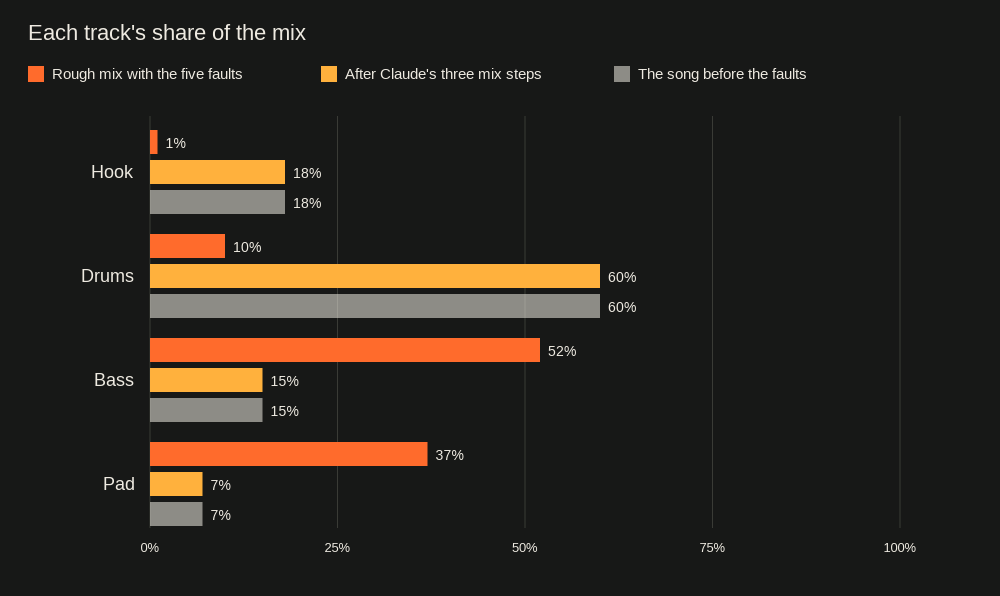
analyze_mix. Claude's mix and the original have the same numbers. Download: SVG; the numbers are in measurements.json.How close it came to the original
Claude never saw the song before the faults. Whole-song numbers:
| Rough mix | After Claude's mix, and the song before the faults | After mastering | |
|---|---|---|---|
| Integrated loudness | −16.1 LUFS | −17.0 LUFS | −14.0 LUFS |
| True peak | −2.0 dBTP | −1.6 dBTP | −1.0 dBTP |
| Loudness range | 6.0 LU | 3.2 LU | 2.9 LU |
| Stereo correlation | 0.79 | 0.96 | 0.96 |
| 40–80 Hz | −19.3 dB | −21.2 dB | −18.1 dB |
| 80–160 Hz | −27.6 dB | −24.0 dB | −21.1 dB |
| 160–315 Hz | −26.2 dB | −29.0 dB | −26.0 dB |
| 630 Hz–1.25 kHz | −39.4 dB | −33.3 dB | −30.2 dB |
| Left minus right | +2.08 dB | +0.02 dB | +0.02 dB |
The mix got 0.9 LU quieter: the +6 dB on the bass and the +10 dB bell on the pad added more level than the restored kick and hook.
The middle column is one column because the audio is one audio: we subtracted Claude's render from the render of the song before the faults and all 8,640,000 stereo frames were identical. The two 8-Band EQs are still in the chains, one band off and one flat, and pass the audio unchanged.
The match is exact because every fault had a neutral position to return to. Each fault moved one setting off a neutral position (a fader at 0 dB, a centred pan, a flat band), and each fix put it back. For the bass and the hook, unity was a judgement, and Claude's notes say so. Had the original hook sat at −4 dB, the same move would have missed by 4 dB.
Mastering for streaming
Claude mastered last, as monody's mixing reference says. The producer named no platform, so it used monody's streaming preset, −14 LUFS and −1 dBTP (where those numbers come from, why −1 dBTP). master_to_target added one Maximizer to the master bus, labelled "Limiter (−14 LUFS)": +3.18 dB of gain into a −1.1 dB true-peak ceiling. Result: −14.0 LUFS, −1.0 dBTP, loudness range 3.2 → 2.9 LU.
Loudness mode only. The song measures darker than monody's balanced reference (a tilt of −5.9 dB per octave against about −4.5), but the reference calls that a heuristic and keeps tonal mode for producers who ask about tone. Claude reported the tilt and left the master's tone alone.
What did not go cleanly
One read was over the answer size. To check for clip-level gain, Claude asked for four clips at once. An answer holds 20,000 characters; the four clips came to 28,874. monody answered answer_too_large with each clip's size, and Claude split the read in two. The clips were MIDI, which has no clip gain in monody, so it only ruled that out.
mix_relation measures the pair, not the cause. With the kick behind the 180 Hz low cut, it read the kick at −43.2 dB below 150 Hz and the bass a median 22 dB above it, and reported no finding. Its one candidate was a kick-keyed Compressor on the bass, tried on a copy and marked "improves" (bass over kick 22.0 → 16.9 dB). That turns the bass down under a kick with no low end. Claude's note before the call already pointed at the EQ; with the band off, the kick measured −21.4 dB and its decay went from 40 to 155 ms. The measurement was right. Which track was wrong came from reading the session. Kick and bass masking covers when ducking is the right move.
The second analysis after mastering added nothing. master_to_target measures the song before and after and returns both, and monody's mixing reference, which Claude had read, says no further analyze_mix is needed. Claude ran one anyway, expecting a fresh render. It came back in 11 ms with the same text; the two earlier runs took 5.6 and 5.2 seconds. monody answers a repeat analysis of an unchanged song from the measurement it already has. For a second opinion Claude measured all three renders with a different meter, FFmpeg 8.0.1's EBU R128 filter. Integrated loudness agreed to the tenth at every stage, true peak within 0.1 dB (−1.1 dBTP against monody's −1.0 after mastering).
Left against right came from the render file. get_project gave the pan and analyze_mix the stereo correlation (0.79 here). For how much louder one side was, Claude measured each channel per section from the render's WAV with a short script. The Break, where the pad carries the section, was 16.7 dB louder on the left.
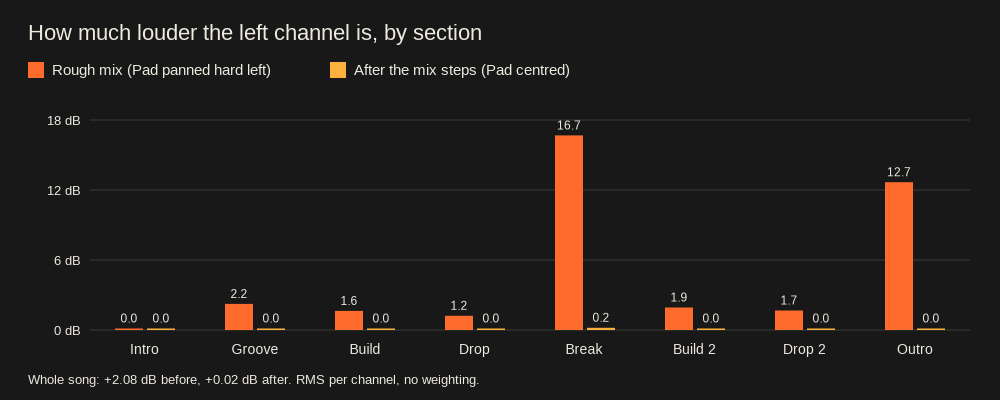
Two things it left alone. In the first drop the bass still rings a median 125 ms under each kick, 5.3 dB below it, and mix_relation still flags it. The duck it tried would put the bass 13.3 dB under the kick, cost 2.8 dB of bass level and cut the overlap from 125 to 15 ms. The producer asked to keep the sounds, so Claude offered it instead. The dark tilt stayed too. Both are in the original as well.
What this test does not show
- Every fault was a setting. Anything that reads every fader and device can see one. A problem inside a sound, a harsh sample or the wrong kick, needs ears.
- Claude knew faults had been planted. A real rough mix doesn't announce that. We gave the same rough mix to Codex without that hint: Codex for music production.
- The planted EQs had newer device ids than the rest of the session, which marks them as added last. Claude pointed that out after the session; its call notes and verdict rest on the settings and measurements above.
- Nothing here measures taste. Claude worked from numbers and settings, not sound (what it gets instead). Where the hook should sit is a listening decision.
What Claude told the producer
The reply from its verdict, written before it saw the list of faults, unedited:
Five settings were off. The drum kit sat behind a steep low cut at 180 Hz, so the kick had almost no body: below 150 Hz it read 22 dB under the bass. That band is off now. The bass fader was at +6 dB and the bass was half the mix; it is back at 0 dB, about 5 dB under the kick on each hit. The pad had a +10 dB boost at 250 Hz and was panned hard left (in the break the left channel was 17 dB louder than the right); the boost is out and the pad is centred. The hook was at -12 dB, 1% of the mix; it is at 0 dB. Then the master: one limiter, streaming target, measured at -14.0 LUFS and -1.0 dBTP. Notes, sounds and arrangement are untouched, and each step is its own undo. Please check by ear: the hook level, whether the bass wants a duck under the kick (it still rings about 125 ms into each hit), the top end, which measures dark, and the kick's attack through the limiter. I measured all of this; I did not hear it.
verdict.json rates its confidence in each finding: 5 out of 5 for the two EQs, 4 for the faders and the pan. The MCP page has monody's tool list and setup, Claude for music production covers connecting, and DAW MCP servers compares which other DAW servers can measure audio.
We ran this on 24 November 2026 with monody 0.9.7 on a Mac and Claude Opus 5.5 in Claude Code. Every tool call went to monody's built-in MCP server on the same computer and was logged with the reason Claude wrote before it: all 32 are in session-log.json, with local folder paths, one internal label and the logging script's name replaced. The server played into a silent test device; nobody listened during the session. All three renders reproduce bit for bit in the released 0.9.7 app. The excerpts are sample-exact cuts of bars 33 to 48 at 192 kb/s; their loudness is FFmpeg's reading of the MP3s. The figures are drawn by scripts from measurements.json. MCP is part of every monody plan, Free too, with a monody account and your own Claude Code access; MCP calls do not spend monody's AI credits.
Sources
- This session: session-log.json, verdict.json, measurements.json (24 November 2026)
- monody: MCP server and tool list (read 24 November 2026), plans (read 26 November 2026); monody 0.9.7's source for how a repeat analysis of an unchanged song is answered (read 24 November 2026)
- FFmpeg: ebur128 filter, version 8.0.1 (read 24 November 2026)
Claude, Claude Code and FFmpeg are trademarks of their owners. monody is not affiliated with or endorsed by Anthropic or the FFmpeg project.
Questions
- Can Claude mix and master music?
- Not by listening. Connected to a DAW that can render and measure the song, it can read every setting, find level, EQ and pan problems, change them as undoable edits and master to a loudness target. In our test it found all five planted faults; whether the result sounds right is still decided by ear.
- Can Claude master music?
- For loudness, yes, through a DAW tool that measures. In our session monody's master_to_target put one limiter on the master bus and the song measured -14.0 LUFS and -1.0 dBTP (FFmpeg read -14.0 LUFS and -1.1 dBTP). Claude left the master's tone alone because nobody asked for tonal changes.
- Can Claude mix songs?
- It can rebalance a session it can read: faders, pans and EQ bands. In our test that took three edits, each one undo step, and the mix came back identical to the song before the faults. It worked from numbers and settings, not from hearing the mix.
- What does Claude need to mix in a DAW?
- An MCP connection to a DAW that exposes the mixer and devices and can render and measure audio. monody has one built in. Without measurement tools Claude can only change settings from your description.