MCP
Codex for music production: a broken mix and a bassline, logged
What OpenAI's Codex can do in a DAW over MCP, from two logged sessions in monody: a broken mix it had to fix and an 8-bar bassline, with audio and numbers.
The short answer. Codex is OpenAI's coding agent. Connected to a DAW over MCP it reads the session, writes notes and changes settings; in our sessions it got no audio, only text. We gave it the broken tech house mix that Claude Opus 5.5 fixed in our mix and master test, without telling it, as Claude had been told, that faults were planted. On the CLI's default model (gpt-6-luna), in 77 seconds and 12 tool calls, it mastered to −14.0 LUFS, partly fixed three of the five faults and missed two, one of them a low cut that had taken the kick's low end. A try on gpt-6.2-astra stopped at once: Codex said the model is not supported when it is signed in with a ChatGPT account. Asked for a bassline, it wrote 8 bars that follow the chords, repeating one 2-bar pattern.
We make monody, a DAW with an MCP server built in, so the sessions ran in our app, logged call by call.
What Codex is, for a producer
OpenAI's CLI page says Codex can "inspect, edit, and run code from your terminal". It runs in the ChatGPT desktop app (where you choose ChatGPT or Codex), the Codex CLI, an IDE extension, the web and Codex Cloud. OpenAI's pricing page includes Codex in the ChatGPT Free, Go, Plus, Pro, Business, Edu and Enterprise plans; for Free and Go it says "in the desktop app, subject to rollout". The CLI, which our sessions used, first appears on the Plus card.
For music, what matters is that Codex can call tools on your computer, and a DAW's MCP server is one; monody's listens only on 127.0.0.1. Chat on the web reaches only remote servers, which is why a DAW on your computer is Codex's job (the difference, and chat use). In these sessions it got no audio: it sent commands and read answers as text.
Hear the mix
The song is the Claude test's: three minutes of tech house, four tracks, five faults planted and hidden from the undo history (full design). Codex got the same copy and the same words:
This is my tech house track, about three minutes. The rough mix feels off and I can't say why. Mix it and master it for streaming. Don't change the notes, the sounds or the arrangement. Tell me what you changed and why, and what you'd want me to check by ear.
Two differences from Claude's run. Claude was told that faults had been planted, not how many or where; Codex was told nothing, as a producer with a real rough mix would be. And Claude ran Opus 5.5, while Codex ran its CLI default, which a header run named gpt-6-luna (reasoning effort "none"), the cheapest model on OpenAI's Codex rate card. Our last run tried gpt-6.2-astra, which OpenAI's models page recommends "for the hardest end-to-end work": Codex stopped before any tool call with "The 'gpt-6.2-astra' model is not supported when using Codex with a ChatGPT account" (record). Everything below is the gpt-6-luna run.
The same 30 seconds of each render, bars 33 to 48, the first drop:
Louder tends to win (why to match levels), so the same excerpts with one fixed gain each, plus the song before the faults:
The five faults, one by one
Scored from the session's settings after the run, against the song before the faults:
| Planted fault | Codex left it at | Before the faults | Result |
|---|---|---|---|
| Bass fader 0 → +6 dB | +1 dB | 0 dB | Partly fixed |
| Hook fader 0 → −12 dB | −6 dB | 0 dB | Partly fixed |
| Pad: an 8-Band EQ with a +10 dB bell at 250 Hz | +2 dB | no EQ | Partly fixed |
| Pad pan centre → hard left | hard left | centre | Missed |
| Drums: an 8-Band EQ with a 48 dB/oct low cut at 180 Hz | on | no EQ | Missed |
It also moved Drums 0 → +2 dB and Pad 0 → −3 dB, neither a fault. Then master_to_target put one Maximizer on the master: +6.6 dB of gain into a −1.1 dB ceiling. Notes, instruments, clips and the arrangement are unchanged; its one run_commands call held five commands, all fader and EQ moves.
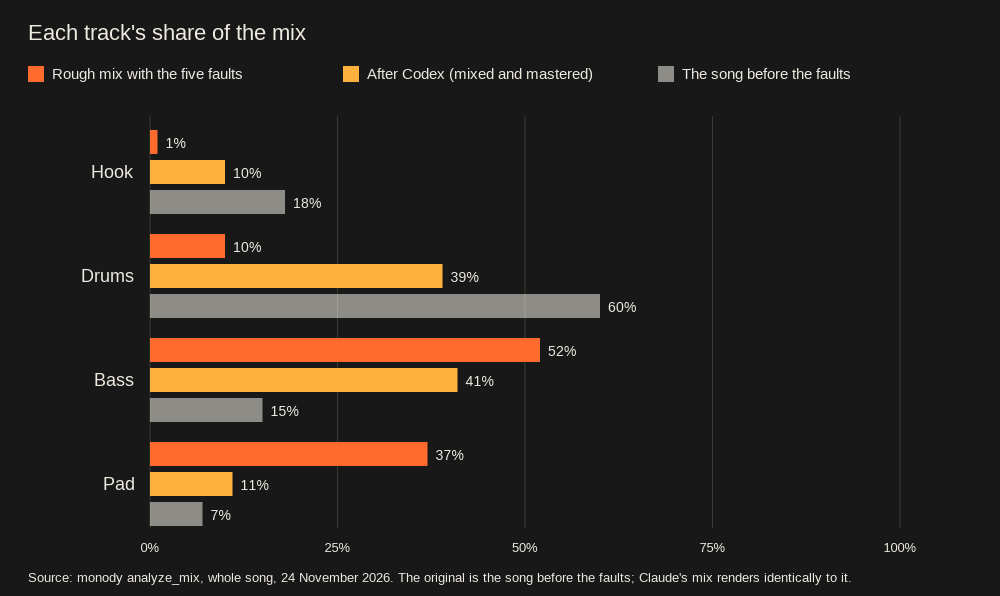
analyze_mix. Codex moved every track toward the original: the pad nearly all the way, the hook and the drums about half, the bass less than a third. Download: SVG; numbers in measurements.json.The two misses were on screen. Codex's first read of the session returned the drum EQ (b1.type: 0, 180 Hz, on) and the pad's pan of −1.0. Its next message named the bass fader and the pad's boost, not these. It never asked monody's reference what band type 0 is (a 48 dB/oct low cut); Claude's session looked up the 8-Band EQ's parameters before its first edit.
The measurements show what was left. In the first drop, below 150 Hz, the kick's track measures −41.2 dB before the master, 2 dB up from the rough mix and 20 dB under the original's −21.4. The bass still sits 15 dB above the kick where the original had it 5.3 dB below. With the pad still hard left, the left channel is 0.7 dB louder over the whole song and 4.4 dB in the Break (rough mix 2.1 and 16.7, original 0.0 and 0.2); correlation reads 0.91 against the original's 0.96.
What Codex did, call by call
Twelve MCP calls, none refused, 77 seconds from start to reply (63 from the first MCP call to the last):
- Read monody's mixing reference and the session, then measured it (
analyze_mix: −16.1 LUFS; the only finding was the loudness gap). - Read the command reference in three parts and opened a named action in monody's history ("Balance and stream master").
- One
run_commandscall: four faders and the pad's bell. Measured again: −20.3 LUFS. master_to_targetfor streaming, then closed the action.
No shell commands, no render of its own. Its reply, unedited:
I rebalanced and mastered the track as one undoable action. The notes, instruments, and arrangement are unchanged.
- Track levels: bass from +6 to +1 dB, pad from 0 to −3 dB, drums from 0 to +2 dB, and hook from −12 to −6 dB. Before the changes, bass and pad made up 89% of the mix; afterward, drums and bass were at 39% and 41%, with the hook at 10% and pad at 11%.
- Pad EQ: reduced its 250 Hz boost from +10 to +2 dB to ease the low-mid buildup.
- Streaming master: added 6.6 dB of gain and true-peak limiting. The verified render measures −14.0 LUFS integrated, −1.1 dBTP, and 5.8 LU loudness range.
The render measurements improved, but I can't judge the sound by ear from them. Please listen to the drop and build transitions, especially for kick and bass separation, whether the drums cut through, and whether the hook still feels present. Also check the limiter for pumping or loss of punch; the master gain increased substantially.
Every number in it matches our measurements, FFmpeg's EBU R128 meter included. Its ear checklist points at the kick and the drums, where the biggest fault was. Full session: codex-mix-session.json.
Next to Claude's run on the same song
Same song, same request, same monody build, and two differences: Claude knew there were faults and Codex did not, and the models differ. Claude's shares and kick are the original's, above.
| Claude Code | Codex CLI | |
|---|---|---|
| Model | Claude Opus 5.5 | CLI default; a header run named it gpt-6-luna, reasoning effort "none" |
| Told faults were planted | Yes | No |
| Tool calls / refused | 32 / 1 | 12 / 0 |
| First MCP call to last | 6.5 minutes | 63 seconds |
| Faults fixed / partly / missed | 5 / 0 / 0 | 0 / 3 / 2 |
| Master gain added | +3.2 dB | +6.6 dB |
| Final loudness, true peak | −14.0 LUFS, −1.0 dBTP | −14.0 LUFS, −1.1 dBTP |
| Loudness range | 2.9 LU | 5.8 LU |
Codex needed twice the master gain because its mix pass took the song down to −20.3 LUFS, the kick it raised still behind the low cut. One run each on one song, with different models and different knowledge of the faults, not a ranking.
Writing notes: an 8-bar bassline
A fresh copy of monody's 8-bar example loop (124 BPM, a kick on every beat, hats, two chords on the Lead track), Codex on the same default model, and this request:
There's a kick on every beat and two chords on the Lead track, A major then F sharp minor, one bar each. Write an 8-bar bassline for this loop on a new track: something that moves, sits under the kick and follows the chords. Pick a bass sound for it. Don't change the other tracks. Tell me what you wrote.
We named the chords because the Lead is an audio clip and nothing in the session states its chords. Eight calls and 37 seconds later it had added a MIDI track, a 32-note clip in one run_commands call and monody's Organ Pluck Bass preset. Other tracks: unchanged.
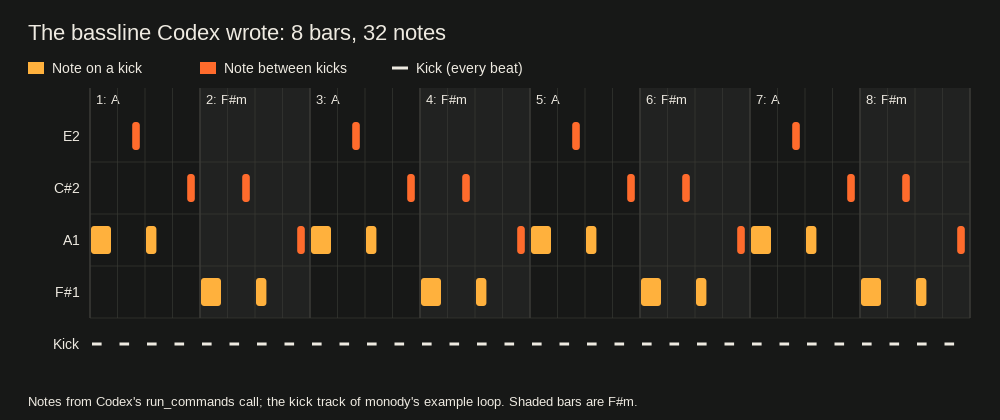
Codex described the line as "A and F♯ roots to follow the chords, with short E, C♯, and A notes on offbeats to add movement and leave space around the kick". The measurement agrees: each offbeat note ends 0.15 beat before the next kick, and the 16 roots start on a kick, which the request's "sits under the kick" allows. monody's mix_relation found bass at exactly those 16 of the 32 kicks, a median 85 ms of overlap there, 4.7 dB under the kick, and reported it as information, not a fault. Codex did not measure or render anything in this session; that check is ours.
What went wrong, and what it cannot do
- It missed the two faults no finding named, the low cut and the pan, as above.
- It stopped halfway. Bass +1 dB and Hook −6 dB are judgement calls; here unity was right.
- "Something that moves" became a 2-bar loop played four times.
- It heard nothing. The mix session ran on settings and monody's measurements, as Codex said itself; the bassline session on settings alone. Whether the bass preset suits the loop is your call (what an agent gets instead of sound).
- The stronger model was refused for the ChatGPT account we used, so this guide shows the default model only.
- It needs a server for your DAW. The 21 we compared differ in what they can change and whether they can measure a render.
Connect Codex to monody
monody 0.9.8 shows everything under Settings → Claude & Codex; the address and the key are your own. In Codex:
- Open Settings → MCP servers → Add server and choose Streamable HTTP.
- Fill in the name
monody, the URL, and one header: the keyAuthorizationwith the valueBearer <your key>. Settings → Claude & Codex in monody shows each of these with its own Copy button. - Save, restart Codex, and ask about your project.
Codex in a terminal or an editor reads the same settings. There you can add the lines monody shows to config.toml, in the .codex folder of your home folder, instead:
[mcp_servers.monody]
url = "http://127.0.0.1:8710/mcp"
http_headers = { Authorization = "Bearer <your key>" }
OpenAI's MCP documentation describes a per-server default_tools_approval_mode (auto, prompt, writes or approve). MCP is part of every monody plan, Free included (Lifetime is $149 once, Pro $14.99 a month or $149 a year, Studio $29.99 a month or $299 a year). Codex runs on your own ChatGPT plan, and its MCP calls do not spend monody's AI credits. The MCP page has the tool list and a first edit to try, and How to make music with Claude walks the same server from an empty project to a WAV.
For Ableton Live through Codex, see Producer Pal in ChatGPT for music production; for other DAWs, DAW MCP servers compared.
We ran the sessions on 24 November 2026 on a Mac, against the same monody 0.9.7 build the Claude test used, served on the same computer from a scratch folder with no key, so Codex's configuration needed only the url line; each published render reproduces bit for bit in the released 0.9.7 app. Codex CLI 0.167.0-alpha.3.2 ran codex exec from an empty folder with our user configuration ignored, a read-only sandbox and monody's tools approved. The mix and bassline sessions used the default model and effort; their JSON logs do not name the model, and a one-line run with the same flags and no MCP server, 41 seconds after the bassline session, printed "model: gpt-6-luna" and "reasoning effort: none". The fourth and last run added -m gpt-6.2-astra and dropped --json so its own header printed; a logging proxy saw only initialize and the tool list. The mix session used 656,541 input tokens (606,336 cached) and 2,116 output; the bassline 264,032 and 1,550. The rough render is bit-identical to the one Claude received. We read the project back, rendered and measured after each run with monody and FFmpeg 8.0.1; excerpts are sample-exact cuts at 192 kb/s, their loudness FFmpeg's reading of the MP3s. Figures are drawn by scripts from measurements.json; session logs have thread ids removed and results shortened. Times in prose run from start to reply; the table row from first to last MCP call, as for Claude. Nobody listened during the sessions.
Sources
- These sessions: codex-mix-session.json, codex-bassline-session.json, codex-astra-attempt.json, measurements.json (24 November 2026)
- OpenAI: Codex pricing and plans, Codex models, ChatGPT desktop app, Codex CLI, Model Context Protocol (read 24 November 2026)
- monody: MCP page, plans (read 24 November 2026)
- FFmpeg: ebur128 filter, version 8.0.1
ChatGPT, Codex and OpenAI are trademarks of OpenAI; Claude and Claude Code of Anthropic; Ableton and Live of Ableton AG; FFmpeg of its project. monody is not affiliated with or endorsed by OpenAI, Anthropic or Ableton.
Questions
- Can Codex make music?
- It can write notes and change mixer and device settings in a DAW it is connected to over MCP. In our sessions it got no audio; it sent commands and read answers as text. It wrote an 8-bar bassline of 32 notes, all tones of the chords we named, and picked a bass preset.
- Can Codex control a DAW?
- Yes, through an MCP server added to Codex in the ChatGPT desktop app's Codex mode, the Codex CLI or the IDE extension. ChatGPT on the web does not read that local configuration, so it cannot reach a server that runs only on your computer directly; OpenAI's route to a private server is Secure MCP Tunnel.
- Can Codex work with Ableton Live?
- Producer Pal, a Max for Live device, connects to Live through Codex; our ChatGPT for music production guide covers its setup, and our DAW MCP servers guide compares the other Live bridges.
- Codex or Claude Code for music production?
- On one broken mix in monody, Claude Opus 5.5 in Claude Code, told that faults had been planted, fixed all five in 32 tool calls. Codex on its CLI default model, gpt-6-luna, not told, partly fixed three and missed two in 12 calls; a try on gpt-6.2-astra stopped at once, because that model is not supported when Codex is signed in with a ChatGPT account. One run each on one song, not a ranking.
- Does Codex cost extra for music work?
- OpenAI's pricing page includes Codex in the ChatGPT Free, Go, Plus, Pro, Business, Edu and Enterprise plans, on Free and Go in the desktop app, subject to rollout. Using it with monody works on every monody plan, Free included, and those MCP calls do not spend monody's AI credits.